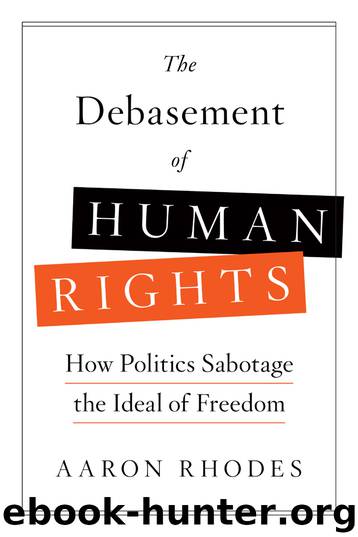
The Debasement of Human Rights by Aaron Rhodes
Author:Aaron Rhodes
Language: eng
Format: epub
ISBN: 9781594039805
Publisher: Encounter Books
Published: 2018-03-06T05:00:00+00:00
The creation of new, collective human rights is clearly a political strategy—a way of weaponizing and instrumentalizing human rights to accomplish political goals of the left.
Exploiting ESCR to Defend Oppression
Since the founding of the modern international human rights system, repressive dictatorial governments have exploited the concept of economic and social rights as a way of masking their violations of freedom while posing as defenders of human rights, and also as a weapon to attack and undermine the legitimacy of liberal democracies whose governments respect individual freedom.
The main outlines of this tendency were established by the Soviet Union in the early years of the international human rights system. Soviet propagandists were obsessed with the concept of human rights, seeing it clearly as the strongest philosophical threat to their hegemony and their appeal to the Third World. At the same time, economic and social rights were central to the self-presentation of Soviet communism—the garb in which it dressed itself up for global inspection. The human rights embraced by the USSR were painted as more consequential than individual freedom rights. “The unity of state and society, and the reality of mass participation in its structures, made Soviet rights stronger than those that existed in the capitalist West,” in this view. “Unlike in the West, rights were founded on true principles of equality, which flowed out of the individual’s organic status inside the state-society unity . . . .”89 Economic and social rights were material gifts of the state, not illusions based on the abstract concept of natural law. Economic and social rights offered concrete necessities, while the individual freedom at the heart of civil and political rights was a recipe for class exploitation, inequality, poverty, moral corruption and disorder.
Soviet ideologues thus turned human rights on their head, making them an instrument for aggrandizing rather than limiting the power of the state. At the Washington Summit of 1987, Mikhail Gorbachev denounced America’s rejection of economic and social rights, asking, “What moral right do you have to give us lectures?”90 When the Soviet Union was coming apart in 1989, he still vigorously defended the economic and social rights it promised, pushing back against claims that the system trampled on human nature.
Soviet theorists constructed a template for rationalizing oppression by invoking respect for economic and social rights—a pattern that has become traditional since the end of the Cold War. The elevation of the “indivisibility” of human rights to an official doctrine of the United Nations has encouraged this theme to spread around the international community. It has become an accepted truism that freedom cannot be enjoyed without “conditions” being provided by the state. Repressive states have increasingly gone on the offensive about human rights, using the concept of economic and social rights to undermine their critics and clothe themselves in moral legitimacy. Elliott Abrams provided this example of dictators “reviving the old Soviet Line”:
Just before his visit to Washington [August 2009], Egypt’s President Mubarak did an interview with Charlie Rose, who raised the issue of human rights (tepidly, it must be said).
Download
This site does not store any files on its server. We only index and link to content provided by other sites. Please contact the content providers to delete copyright contents if any and email us, we'll remove relevant links or contents immediately.
The Vikings: Conquering England, France, and Ireland by Wernick Robert(84227)
Ali Pasha, Lion of Ioannina by Eugenia Russell & Eugenia Russell(40255)
The Conquerors (The Winning of America Series Book 3) by Eckert Allan W(37473)
The Vikings: Discoverers of a New World by Wernick Robert(36978)
Cecilia; Or, Memoirs of an Heiress — Volume 1 by Fanny Burney(32558)
Cecilia; Or, Memoirs of an Heiress — Volume 2 by Fanny Burney(31956)
Cecilia; Or, Memoirs of an Heiress — Volume 3 by Fanny Burney(31941)
Empire of the Sikhs by Patwant Singh(23084)
The Secret History by Donna Tartt(19086)
Hans Sturm: A Soldier's Odyssey on the Eastern Front by Gordon Williamson(18590)
Cat's cradle by Kurt Vonnegut(15352)
Pimp by Iceberg Slim(14506)
Sapiens: A Brief History of Humankind by Yuval Noah Harari(14389)
Talking to Strangers by Malcolm Gladwell(13370)
Norse Mythology by Gaiman Neil(13363)
Leonardo da Vinci by Walter Isaacson(13336)
4 3 2 1: A Novel by Paul Auster(12391)
Underground: A Human History of the Worlds Beneath Our Feet by Will Hunt(12097)
The Radium Girls by Kate Moore(12028)
